CD Cover Art

January 25, 2010 by wkimball · Leave a Comment 

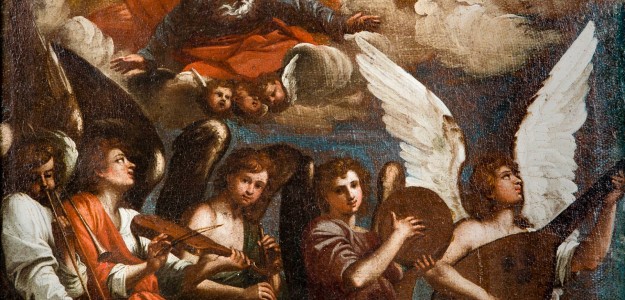
Just noticed today that the cover jacket for Christian Lindberg’s new CD, The Baroque Trombone, released last September, uses one of the images included in the Trombone History Timeline. The image, shown below, was added to the 17th century timeline in October 2008. I came across the painting for the first time while tracking down another painting by the same artist, Lionello Spada; that painting is also shown below. I think they’re two of the most beautiful depictions of the early trombone in visual art.

1615—Reggio Emilia, Italy: Lionello Spada’s fresco in the cupola of the Chiesa della Ghiara includes depictions of numerous angel-musicians, including an angel playing trombone (see facing image; public domain) (Quintavelle, plate 81; Monducci 130).

c. 1610—Rome, Italy: Lionello Spada’s painting, Concert, which shows a group of musicians presumably preparing for a performance, includes a clear depiction of a musician removing the outer slide of a trombone (see below image; public domain) (Egan; Monducci 81).

Perching on the Pipes: Trombone & Organ Images

January 12, 2010 by wkimball · Leave a Comment 

I’ve recently added quite a few images of trombone sculptures on organs to the Trombone History Timeline. The dates of origin of these sculptures are difficult to nail down, as the organs on which they are housed tend to have multiple re-builds and renovations throughout their given histories; it is very likely that I have some of the dates wrong. Nonetheless, they make an interesting little collection of images. The commonalities are 1) with one possible exception, they all appear to depict angel-trombonists, and 2) they all originate from Germany. Obviously, the importance of the trombone in German sacred music (and the German religious tradition in general) is a likely factor.

____________________________

1643—Berne, Niedersachsen, Germany: Renovations of the organ at St. Aegidius Church are completed by Harmen Kröger. It is probably at this time (or possibly at the 1714 renovation by Christian Vater) that a sculpture of a trombonist is added to the organ case (see facing detail and full image below; public domain) (Seggermann 29, 53).

1658—Schöningen, Germany: Jonas Weigel completes the organ for St. Vincenzkirche, which includes a sculpture of an angel-trombonist on the organ case. The angel-musician on the opposite side plays the cornetto (see facing detail and full image, below; public domain).

1697-1703—Görlitz, Germany: Eugenio Casparini’s famous organ in the church of St. Peter und Paul features decorative sculpures of angels sitting atop the pipe structure. Each angel holds 2 instruments; 2 of the angels, sitting on opposite outside edges of the structure, hold trombones while playing trumpets (see above) (Sonnaillon 92). For a better image, see here.

1701—Lauffen am Neckar, Germany: The organ housing at the evangelische Kirche St. Regiswindis includes 2 sculptures of angel-trombonists, the angels apparently playing one-handed (see facing detail and full image below; public domain) (Völkl 50).

1714—Lüneburg, Germany: A major rebuild of the organ in Johanniskirche is completed by Matthias Dropa. One of several rebuilds and renovations after the organ’s original installation in 1551-53, it is probably this early 18th-century rebuild that adds the sculptures of what appear to be 2 angel-trombonists perched atop the organ pipes (see facing detail and full image, below; public domain).

1770-73—Salem (Baden), Germany: The organ in Salemer Münster, or Salem Abbey, includes a sculpture of a trombonist atop a set of pipes (see facing detail and full image, below; public domain) (Könner, Abb. 99).

Still Another 17C Italian Angel-Trombonist

December 26, 2009 by wkimball · Leave a Comment 

Added the below images and caption to the Early 17th Century Trombone History Timeline. The instrument appears to be a trombone, although the left-hand grip of the player is unusual. Again, like many other frescoes from this region and time period, the image would seem to reflect the religious connections in trombone history.

1623—Varese, Italy: Cappella XI, cappella della Resurrezione, of Sacro Monte, is completed. The semicircular apse features a fresco by Isidoro Bianchi that includes what is probably a trombone among one group of angel-musicians (see facing detail and bottom-left of full image, below; click for larger image; public domain) (Angelis 147).

Yet Another Angel-Trombonist from 17th-Century Italy

December 21, 2009 by wkimball · Leave a Comment 

I recently posted a blog entry (here) that mentioned how common paintings of angel-trombonists from 17th-century Italy are, reflecting as they do the sacred nature of the trombone. Below is yet another painting that I’ve located. The detail of the top portion, along with the entry, has been posted in the 17th century timeline (first half). The full image, included here below the detail, was not included in the timeline because of space. The painting is noteworthy for its expressive, individualistic style.

c. 1625—Ascona, Italy: Giovanni Serodine paints Coronation of the Virgin with Saints in Ascona’s parish church. The image features a consort of angel-musicians playing 2 viols, cornetto, and trombone (see facing detail of top portion of painting; public domain).

Serodine, Coronation of the Virgin, upper detail

Serodine, Coronation of the Virgin, full image

Angel-Trombonists, Italian Painters, and the 17th Century

December 16, 2009 by wkimball · Leave a Comment 

Added another image of an angel-trombonist to the Early 17th Century Timeline (see images and timeline entry, below). Trombone history seems to replete with these striking paintings, particularly by Italian artists, depicting the sacred nature of the trombone. See especially 17th Century (first half) and 17th Century (second half).

_______________

Proso di Piuro detailProso di Piuroc. 1641—Prosto di Piuro, Valchiavenna, Italy: A fresco in the vault of the presbytery of chiesa dell’Assunta painted by either Giovan Battista Recchi or his brother, Giovan Paolo Recchi, includes a trombonist among several angel musicians (see facing detail and full image, below; public domain) (Pescarmona 77).

Trombone History: Another Curious Image

December 7, 2009 by wkimball · Leave a Comment 

Added the below trombone images and entry to the 16th Century (first half) Timeline.  This particular trombone image shows characteristics of both a slide trumpet (e.g., the long bell section, the low brace between bell and slide that would preclude movement of a double slide) and a trombone (e.g., a possible double slide, the overall length, the way the instrument is not being gripped near the mouth, and the curve of tubing that extends behind the head). This depiction’s ambiguity places it among other “Curious Images” that may represent the transition between slide trumpet and trombone. As always, the thing to remember, of course, is that artwork is not always literal.

Fiammenghino-detailFiammenghino-medium1608—Gravedona, Italy: Glory of God the Father and the Angels, a fresco by Giovanni Mauro della Rovere (also known as Fiammenghino), located in the Church of Santi Gusmeo e Matteo, includes a depiction of what could be a trombone. The instrument has characteristics of both slide trumpet and trombone; it could simply be an awkwardly-rendered depiction of either instrument. Other nearby angel-musicians play viol, organ, flute, and lute (see facing detail and medium detail below; public domain) (Angelis 43).

Trombone History: Another angel-trombonist

December 2, 2009 by wkimball · Leave a Comment 

Found the below painting and posted it in the Trombone History Timeline–17th century (2nd half). Another nice religious image. The angel almost looks a bit soulful!

passau cathedral1668-93—Passau, Germany: Carpoforo Tencalla’s fresco in St. Stephan’s Cathedral includes depictions of many angel-musicians, including a trombonist (see facing image; public domain) (Crombie 50).

Trombone History: Angel-Trombonist in 16th Century Altarpiece

November 24, 2009 by wkimball · Leave a Comment 

Added a really nice painting by German artist Hans Baldung to the 16th Century Timeline, dating from fairly early in the history of the trombone. The angel’s grip of the slide is interesting, but probably not a literal representation. In general terms, notice the fairly equal balance of religious versus secular trombone iconography from the 16th century.

Baldung detailBaldung1516—Freiburg, Germany: Hans Baldung’s painting, Coronation of the Virgin, the central panel of an altarpiece located in the Freiburg Cathedral, includes an angel-trombonist among a group of angels playing wind instruments above and to the left of the Virgin (see facing detail and full image, below; public domain) (Burkhard pl. 2).

Trombone History: early rear-facing trombones

November 12, 2009 by wkimball · Leave a Comment 

Found the below Italian fresco that features a rear-facing (or over-the-shoulder) trombone and added it to the early 17th century timeline. I know of only one other pre-19th century image that clearly shows such an instrument; I’ve included that image in this post as well (1578). (I have seen a few others that seem to suggest a similar instrument but are more vague, sometimes simply showing what appears to be a slide portion with no bell at all.) The fresco from c. 1615 is also of interest because it has only recently been restored (and, indeed, at the base of the photograph you can see what appear to be some restoration materials). Also noteworthy is the trombone’s bell flare, which is more prominent than usual for this early date. Finally, as I have mentioned several times, it is quite arresting just how many trombone images originate from the 50-year period of 1601-1650.

Cislagoc. 1615—Cislago, Italy: The Church of Santa Maria della Neve contains an anonymous fresco lunette featuring several angel musicians, including a trombonist. The trombone is particularly noteworthy because it is a rear-facing (sometimes called “over-the-shoulder”) instrument, an unusual configuration for this early date (see facing image; public domain) (Morandi; Farioli). For another early rear-facing instrument, see 1578 in the 16th century timeline, where a cherub-trombonist is featured. In later centuries, particularly the 19th century, rear-facing trombones become much more common; the 19th century timeline includes at least 9 such images.

initial-d1578—Antwerp, Belgium: A set of masses by George de La Hele includes an image–an initial D in front of a group of cherub musicians–that features a rear-facing trombone being played by a cherub (also rear-facing) (see facing image; public domain; Wangermée vol. 1 167).

Trombone History: from the balcony

November 11, 2009 by wkimball · Leave a Comment 

Added the following 3 images and entry to the 17th century timeline (1st half). The fourth image, a drawing, is clearly related, although it comes from a separate source; I expanded its entry to include a reference to the painting. As I have mentioned before, the concentration of trombone images from this half of the 17th century is remarkable.

Reni Gloria leftReni Gloria rightReni Gloria1609—Rome, Italy: Guido Reni’s Gloria d’angeli, a fresco located in S. Gregorio Magno, Cappella di S. Silvia, includes 2 trombones (see above details and full image) (Cavalli, pl. 28 and 32; Pepper, pl. 30). A drawing pictured elsewhere (see 1600s—Southern Netherlands) is almost certainly either a preparatory sketch for or a copy of Reni’s painting.

La Musique 2871600s—Southern Netherlands: An anonymous 17th century drawing portrays five angel-musicians, including a trombonist, performing from a balcony or platform. Separate leaves of music for four of the five players are pictured draped over the edge (see facing image; public domain) (Paris, Louvre; Wangermée vol. 1 287). The drawing is clearly either a preparatory sketch for or a copy of Guido Reni’s fresco, Gloria d’angeli (see 1609).