I just added this photo and caption to the Trombone History Timeline (20th century). 1929-30—A photo of the trombone class at Paris Conservatory, 1929-30, features Henri Couillaud, trombone professor (see below image; public domain).
Painting of Buccins in 19th Century Church
I just added this painting and caption to the Trombone History Timeline (19th century, 2nd half). The use of plainchant, played on buccins and trombones, in the late 19th century, is all noteworthy. The painting is also striking in its…
Angel-trombonist plays from balcony near Venice
I’ve just added this image and caption to the Trombone History Timeline, 18th century. It’s particularly interesting because it’s a little late for trombone angels, especially in Italy. c. 1775—Bassano del Grappa, Italy: A ceiling fresco by Giovanni D’Antona in…
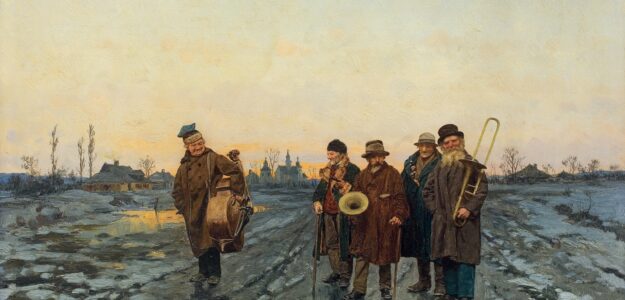
Polish Village Musicians, 1875-1880
I recently added the below set of images by Polish artist Franciszek Streitt to the Trombone History Timeline (19th century, 2nd half). The colorful picture they collectively paint of a slice of late 19th-century musical life is fascinating. Click on…
2 Timeline Updates from Poland
I just added 2 images and their captions to the Trombone History Timeline (17th century, 1626-1650 and 19th century, 1801-1825). Both are from Poland. 1649—Wladyslaw, Poland: The drawing, Orchestra of Wladyslaw IV Vasa, includes at least one trombone (see center-left of…
The Low Countries, Muses, and a Trombone in the Dirt
I just added the below image and caption to the Trombone History Timeline, 17th Century (1601-1625) and to the blog post, Pick That Thing Up and Play! c. 1620—Antwerp, Belgium: In a painting called Minerva Visits the Nine Muses, attributed to…
Update: Trombone on Harpsichord Lid
I updated my previous black and white image with the detail and full image shown below. See Trombone History Timeline, 17th century (1626-1650). Special thanks to Tassos Dimitriadis. c. 1630—Antwerp, Belgium: A painting on the lid of a harpsichord by…
Another Rear-Facing Trombone from 19C France
I just added the below image and caption to the Trombone History Timeline (19th century: 1826-1850) and to the collection of rear-facing trombone images, Backward Advances: Rear-Facing Trombones throughout History. c. 1828—Paris, France: Frédéric Bouchot’s La Grisette abandonée, No. 2,…
Elegant Woman Trombonist from 16th-17th Century
I just added this beautiful picture to my collection of iconography. You can find it in historical context in the Trombone History Timeline (16th century). 16th-17th century—Southern Germany: An inlaid panel with various woods by an unknown artist depicts a richly-dressed…
Out in the Cold
I added the image and caption below to the Trombone History Timeline (19th century, 2nd half). Enjoy! 1883—Royal Waits Outside Marlborough House (London residence of the Prince of Wales), a caricature by an unidentified artist, includes a trombonist playing with a…