Alto Trombone
One of my primary areas of interest as a performer and researcher is alto trombone. Below are a few articles, along with some other alto-related stuff that may be of interest. I try to strike a balance between research, pedagogy, and performance. As always, your questions and comments are welcome.
Research & Pedagogical Materials

Alto Trombone Timeline: The alto trombone timeline I’ve posted here was initially just a subset of the general Trombone History Timeline found elsewhere on this site; however, it now has significant additional content not included in the general timeline. It draws from many of the most recent, up-to-date sources, as well as more than 100 primary sources. All the references are found in the Alto Trombone Bibliography; readers are encouraged to explore the sources in order to get broader context for timeline entries. Images in the timeline are either used by permission or fall in the public domain. Like the general timeline, it’s a work in progress—still much to add, revise, etc.
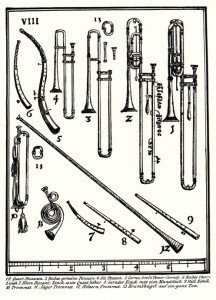
Praetorius on Alto Trombone: Here’s why the partial-sentence that some scholars are fond of quoting is perhaps something short of the full story.
Alto and Voice: One of the attractive aspects of alto trombone literature is the amount of rewarding music written for alto trombone and voice. There are a number of beautiful late Baroque and Classical works that provide a welcome change of pace in a trombone recital.
Extant Altos: From time to time there is an argument set forth that we really shouldn’t be using alto trombone so much. Here’s what a close look at the many existing pre-1800 alto trombones may bring to bear on the discussion.
Alto Quotes: See a sampling of positive aesthetic opinions about the alto trombone (its benefits, sound, etc.) from a wide range of respected musicians and commentators, including a noteworthy letter by Johannes Brahms.
Treatises on Alto: Treatises, dictionaries, and methods on alto trombone, 1600-1925. This is a chronological listing of what more than 60 sources, the majority of them primary sources, have to say about the alto trombone and its role in trombone history. These written materials, taken as a whole, strongly suggest 1) a relatively common instrument, 2) an instrument very consistently pitched in the E-flat orbit (D, E-flat, F), and 3) an instrument closely correlated with alto clef.
Alto Trombone Slide Position Chart: One of the most frequent requests I get is for a basic alto trombone position chart. Here it is, in pdf format. Enjoy!

Learning the Alto Trombone: Drawn from my own playing experience, research, and 17 years of full-time college teaching, here are a few suggestions for learning the alto trombone.
Blog on Alto: Check the Alto Trombone category of my blog for updates on any of the above pages. Viewer comments can easily be posted on individual blog entries. My response to a blog comment on Howard Weiner’s 2005 article, “When is an Alto Trombone an Alto Trombone…,” can be found here in the blog.
Performance

Solo CD, “Collage”: My solo CD includes Leopold Mozart’s Concerto for Alto Trombone and an arrangement of Faure’s “Pie Jesu” (from his Requiem) for alto trombone and organ. The Faure arrangement is also featured on a Tantara compilation CD titled “Escape to a Place of Peace and Calm.“
Solo Recitals: I try to fit in an alto trombone piece on most solo recitals that I play. It provides a nice change of tone color and a little variety in literature. Solo alto repertoire I’ve enjoyed performing recently has included Albrechtsberger, Concerto; Leopold Mozart, Concerto; Zechner, Aria Solemnus; Anonymous, St. Thomas Sonata; Tartini, Concerto (arr.); and Faure, “Pie Jesu” (arr.). In 2014 I was honored to premiere “am strigat…am legat,” an alto trombone concerto by BYU composition professor Neil Thornock, with the BYU Philharmonic Orchestra.

Utah Trombone Authority: A trombone quartet with Jim Nova (Pittsburgh Symphony, formerly Utah Symphony), Rusty McKinney (formerly Utah Symphony), Mark Ammons (Brigham Young University), and myself. Our 2008 CD, Utah Trombone Authority, is produced by Tantara Records. I occasionally used alto trombone with quartet, including on the Persichetti hymns we arranged and on Elizabeth Raum’s Fanfare. A new quartet written recently for us by composer Neil Thornock also features alto trombone as the top voice.

Utah’s Ultimate Trombone Ensemble: A now-defunct professional trombone ensemble, led by Rusty McKinney, that met regularly in Salt Lake. The group included Utah Symphony members, college professors, and area professionals. Arrangers for the group wrote some very challenging alto parts; our 2 performances at the 2008 International Trombone Festival featured quite a bit of alto, including an arrangement of Copland’s Fanfare for the Common Man featuring 6 alto trombones (an act that was, as Rusty McKinney puts it, “probably illegal”).

Other Materials (Published)
Kimball, Will and Joseph Hansen, “Alto Trombone Pedagogical Materials.” International Trombone Association Journal (Winter 2007).
J. Mark Thompson, ed., Solos for the Student Trombonist, 2nd ed. Vuarmarens, Switzerland: The Brass Press/Editions BIM, 2004. One of 15 contributors; 11 alto trombone entries.
Kimball, Will, “The Rise and Fall . . . and Rise of the Alto Trombone.” National Association of College Wind and Percussion Instructors Journal (Spring, 2000).
Kimball, Will, “Alto Trombone Solo Literature: An Annotated Bibliography” DMA doc. Arizona State University, 2001.
Kimball, Will, “Music for the Alto Trombone.” The Instrumentalist (January, 1997).